
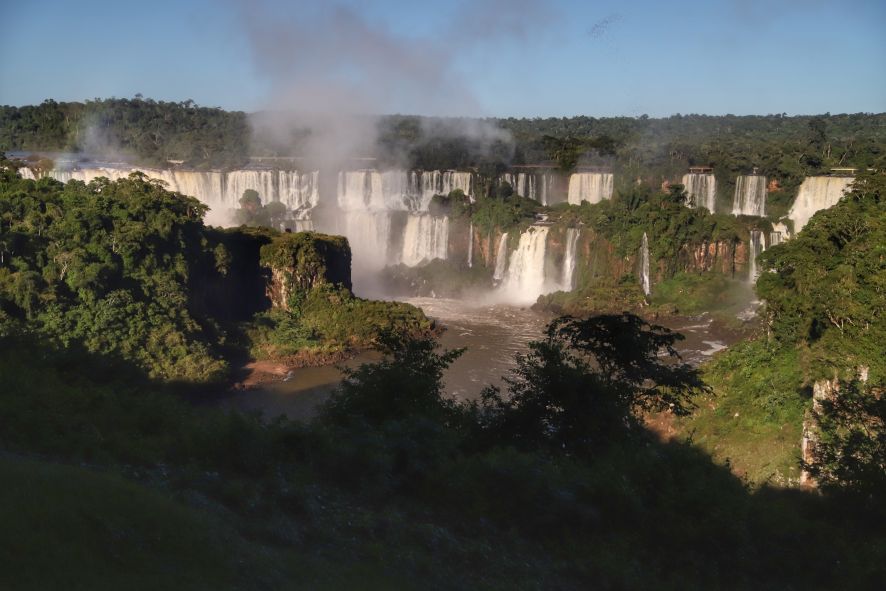
Photography credit on home page: 04/2019 – Foz do Iguaçu – Cataratas Falls.
Author: José Fernando Ogura/ANPr
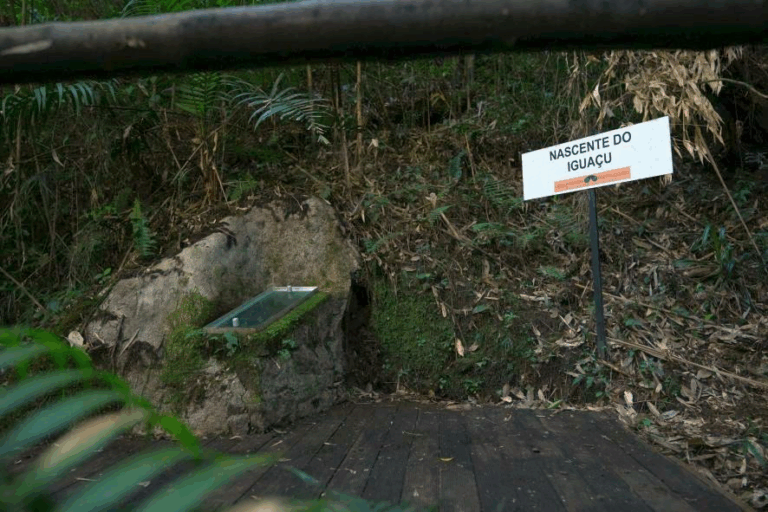
As the Nature Reserve’s name suggests — as “nascentes” in Portuguese means “springs” —, the 13 hectares of protected Atlantic Forest are home to springs that make up the Iguaçu River basin, one of the most iconic rivers in Brazil and South America.
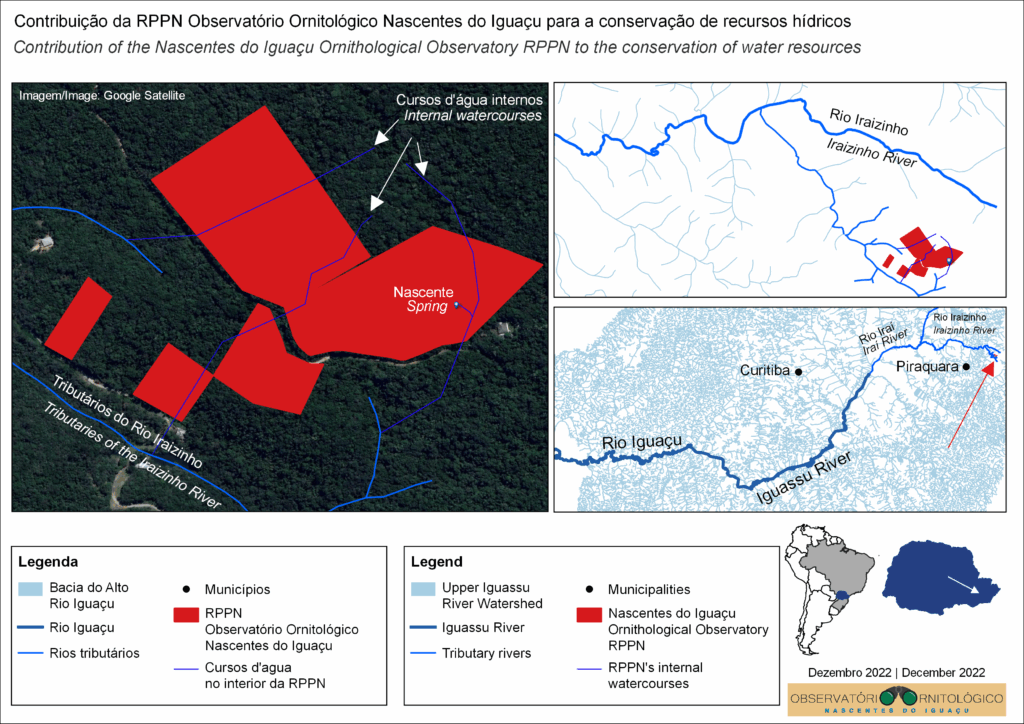
The Iguaçu River, famous for its voluminous and impressive waterfalls—the Iguaçu Falls—has its main headwaters on the western slope of the Serra do Mar mountain range, in the municipality of Piraquara, in the metropolitan region of Curitiba, in Southern Brazil. The springs that originate at the Ornithological Observatory form small watercourses, tributaries of the Iraizinho River, which, a little further on, joins the Iraí River, and the latter joins the Atuba River, a point considered the zero mark or beginning of the stretch officially recognized as the Iguaçu River. At this point, the waters originating at the Ornithological Observatory will have traveled approximately 36 kilometers. After its formation, the Iguaçu River flows for over 1,300 kilometers, crossing distinct geomorphological landscapes in Paraná State, until it flows into the Paraná River, on the border between Brazil, Argentina, and Paraguay.
The Atlantic Forest in the Serra do Mar mountain range plays essential roles in the balance of the Upper Iguaçu River basin: it maintains the perennial flow of water; ensures water quality through natural filtration provided by native vegetation; and supports unique aquatic and terrestrial habitats. At the Ornithological Observatory, the presence of the Atlantic Forest, in an advanced state of conservation, protects the soil against erosion and favors the infiltration of rainfall into the water table, feeding the springs continuously and stably.
This water regime is essential for maintaining local biodiversity, especially for the fauna associated with humid, mountainous, and well-preserved environments. Trail cameras installed within the Nature Reserve frequently capture images of mammals such as Tayra (Eira barbara), Otters (Lutra longicaudis), and Brocket Deer (Mazama americana), among other groups of animals, using the water in the streams.
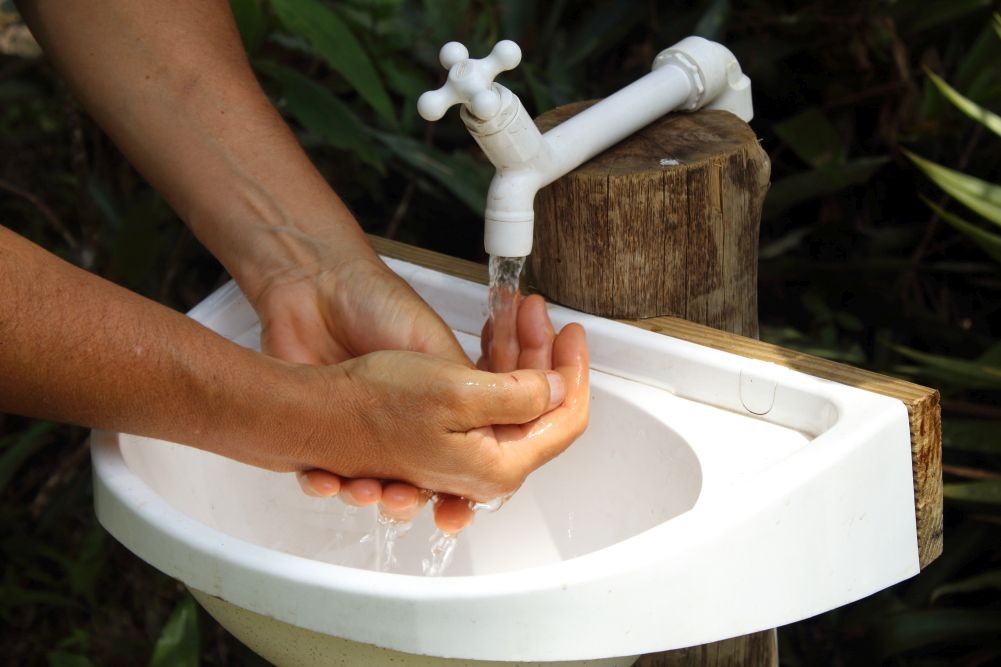
Besides being an essential resource for wildlife conservation, the water sources originating at the Observatory also serve human consumption. On-site water management protected one of the springs, whose water was channeled through a 300-meter pipeline structure, stored in water tanks, and distributed for use at the RPPN headquarters. The water quality was analyzed in a specialized laboratory and certified as Fluoridated Mineral Water with Neutral pH.
In a context of climate change, deforestation, and increasing urbanization, natural spaces like the one protected by the Nascentes do Iguaçu Ornithological Observatory reduce the impacts of extreme events such as droughts or floods, and ensure water in significant quantity and quality to supply human populations and biodiversity.
The Nature Reserve is directly connected to the Iguaçu River both geographically and ecologically. Protecting its headwaters protects the Iguaçu River itself, making the waterway a vital axis of life, culture, and biodiversity conservation on the continent.
Also watch some television reports on the Ornithological Observatory’s relationship with water (avaiable in Portuguese):
©2025 publicado pelo Observatório Ornitológico Nascentes do Iguaçu.
Créditos para fotografias: os autores das fotografias estão identificados junto às imagens.
Quando não há identificação, são fotografias do acervo do Observatório Ornitológico Nascentes do Iguaçu.
Conheça nossa Política de Privacidade.
Conheça nossos Termos de Uso.
To provide the best experiences, we use technologies such as cookies to store and/or access information on your device. Consent to these technologies will allow us to process data such as browsing behavior or unique IDs on this website. Not consenting or withdrawing consent may negatively affect certain features and functions. See our Privacy Policy. See our Terms of Use.