
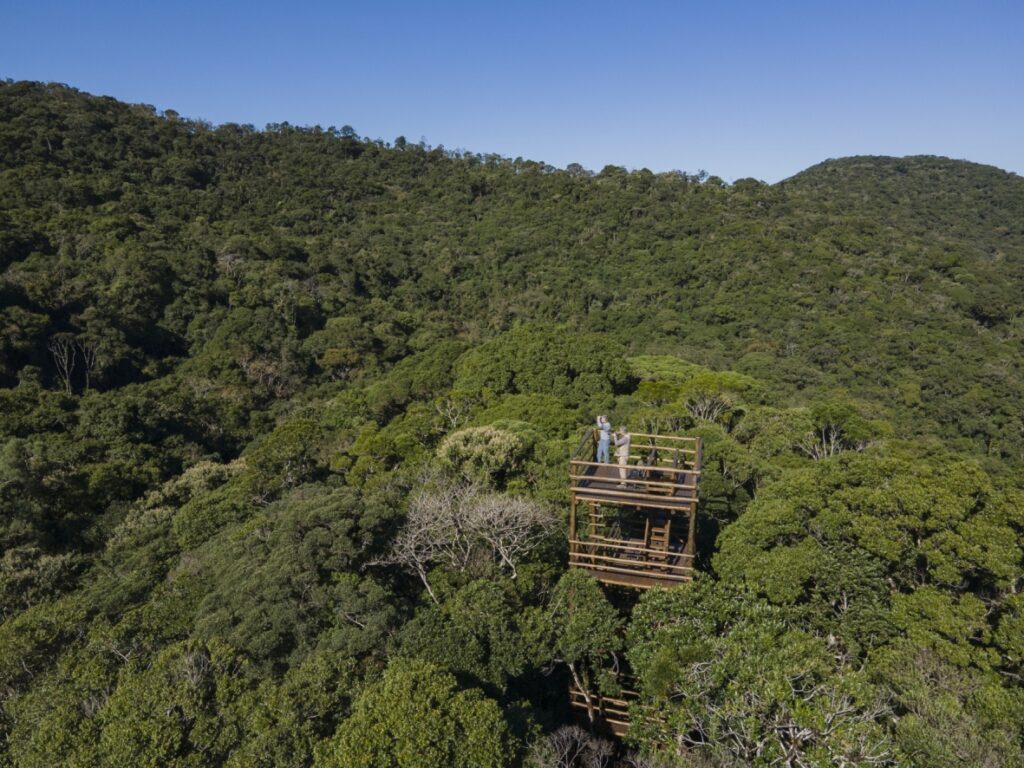
Conceived and designed as a “canopy tower”, the Observation Tower is nestled among tall trees, its summit rising slightly above the canopy. The construction technique and method used in its design are noteworthy, ensuring durability and expanding the options for viewing and admiring the surrounding landscape.
In its construction, autoclaved citriodora eucalyptus was used, with a proven durability of up to 25 years. Robust galvanized hardware was used to secure the wooden trunks, resulting in greater safety for pedestrians traveling along its 65 steps and 13-meter height. The tower’s ascent via five distinct flights of stairs and individual decks allows visitors to visually explore the unique biodiversity of different sections of the forest, including the canopy. For added safety, the upper deck, up to the parapet, is protected by a screen. Two benches and a small table complete the relaxation space on the last two decks, also used for drone takeoffs and landings, supported by a removable drone-pointing platform.
To top it all off, a 2.5-meter horizontal wooden log, hinged, holds a feeder at one end, allowing for bird watching and attraction.
Also on the upper deck, attached to a wooden platform, is a small weather station equipped with sensors to monitor temperature, wind chill, and relative humidity, as well as an anemometer to measure wind speed and direction. All connected and digitally measured by a handheld receiver.
Access to the Tower is via a trail approximately 50 meters long, starting from the main house and illuminated by nine spotlights, facilitating nocturnal birdwatching and other experiences of contact with the Atlantic Forest.
Reaching the top of the tower at the Ornithological Observatory is a unique experience, giving visitors the sensation of being immersed in the Atlantic Forest. From the top, a 360-degree view, stretching 70 km north and west, awaits the observer. Given the Ornithological Observatory’s location in a geographic region subject to numerous climate variations—throughout the day, not just between days—the surrounding landscapes change regularly and sometimes rapidly.
Thus, in this dynamic, a clear view of the mountains at dawn can be obscured within minutes by humid cloud fronts coming from the coast. These clouds, traveling through the valleys between the mountains, bring oceanic humidity to the plateau, almost always accompanied by a cold wind. This phenomenon, called “mountain fog” at the Observatory, is more common in summer and on hot days with high humidity levels.
These are unique moments when visitors and observers can witness the workings of an ombrophilous forest in action, and also collect unique photos of the Atlantic Forest.
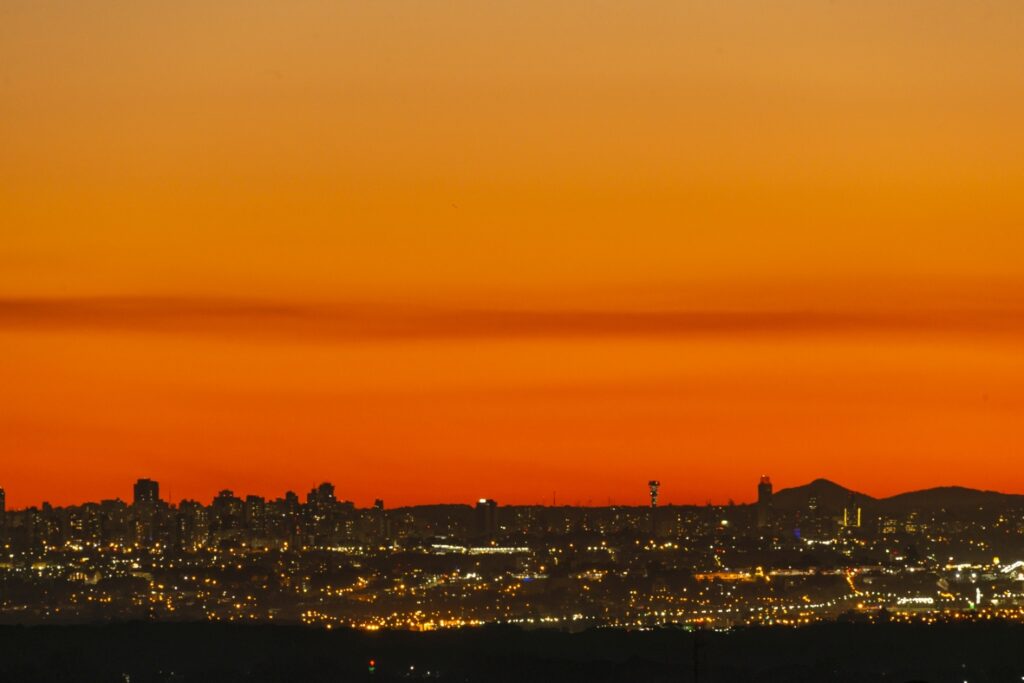
Two other natural spectacles attract visitors to the tower: sunset, at the end of a clear day, and the rise of a full moon, also in a cloudless sky.
©2025 publicado pelo Observatório Ornitológico Nascentes do Iguaçu.
Créditos para fotografias: os autores das fotografias estão identificados junto às imagens.
Quando não há identificação, são fotografias do acervo do Observatório Ornitológico Nascentes do Iguaçu.
Conheça nossa Política de Privacidade.
Conheça nossos Termos de Uso.
To provide the best experiences, we use technologies such as cookies to store and/or access information on your device. Consent to these technologies will allow us to process data such as browsing behavior or unique IDs on this website. Not consenting or withdrawing consent may negatively affect certain features and functions. See our Privacy Policy. See our Terms of Use.